Driving in Armenia: The Rules, the Roads and What Actually Happens
24 September 2026
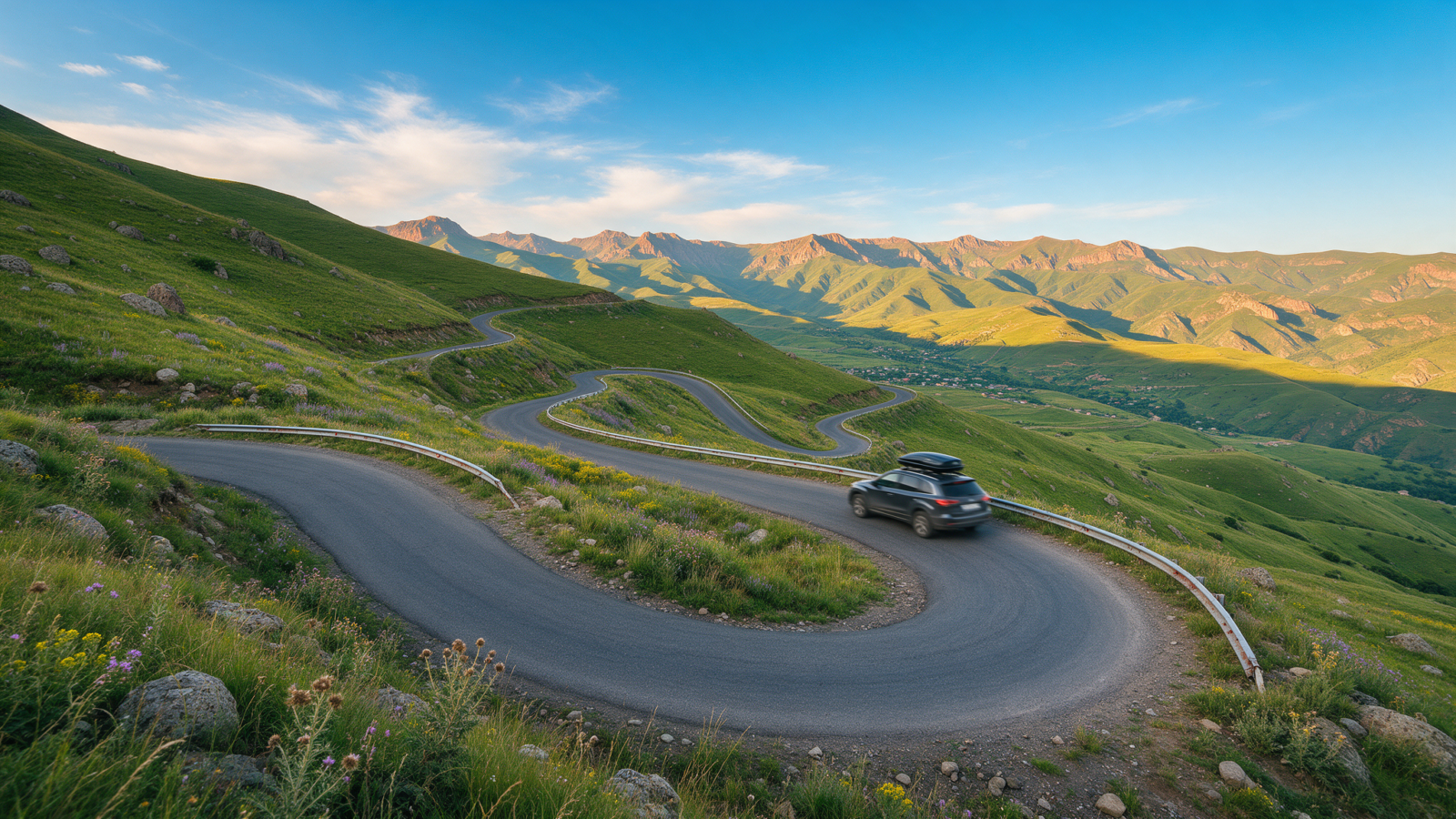
Driving in Armenia is easier than its reputation and harder than the map suggests. The main roads are paved and well maintained, there are no tolls, and the police are straightforward with foreigners. What you have to adjust to is other drivers, mountain distances that take longer than they look, and a speed camera network that quietly writes tickets against your number plate.
On this page
What it feels like in the first hour
You will leave Zvartnots on a good four-lane road and within ten minutes be in Yerevan traffic that behaves differently from anywhere in Western Europe. Lane markings are treated as suggestions. Overtaking happens on both sides. Cars enter roundabouts as though the rule were priority to the right, whatever the rule actually is. Nobody is angry about any of this; it is simply the local grammar, and once you stop expecting European lane discipline it becomes readable.
Then you get onto the M4 towards Sevan or the M2 towards Areni and it changes completely. Intercity roads are quiet, wide enough, mostly in good condition, and genuinely pleasant to drive. The Yerevan half-hour is the hard part.
Every Western foreign ministry says a version of the same thing. The UK’s Foreign Office: “The standard of driving is poor. Be prepared for drivers who drive recklessly and ignore traffic laws.” The German foreign office puts the accident risk substantially above Germany’s. Italy’s Farnesina says driving here is not generally informed by adequate caution. They are describing the same thing you will see in the first hour, and they are right. They are also describing the actual risk of an Armenian road trip, which is traffic — not anything geopolitical.
The rules, in one table
| Rule | Armenia |
|---|---|
| Residential and courtyard zones | 20 km/h |
| Built-up areas | 60 km/h |
| Outside built-up areas | 90 km/h |
| Expressways | 110 km/h where signposted |
| Alcohol | Effectively zero tolerance. Do not drink and drive at all |
| Seatbelts | Mandatory, front and back |
| Phone | Hands-free only |
| Daytime running lights | Not required — unlike the EU and Russia |
| Children under 12 | In the rear, with an appropriate restraint |
| Tolls and vignettes | None for passenger cars |
| Winter tyres | Mandatory 15 November – 31 March, tread above 4 mm |
| Smoking while driving | Prohibited — 7,000 AMD |
A few of those deserve a sentence. Daytime running lights are not required here, which surprises German and Russian drivers who switch them on by reflex — no harm done, it is simply not obligatory. Armenia has very few true expressway sections, so 110 km/h is rarer than the table implies; assume 90 outside towns unless a sign says otherwise. And smoking at the wheel is an offence, which almost no foreign visitor knows.
On alcohol, every official source says zero tolerance and the penalty table starts at 29,000 AMD plus five penalty points. The exact statutory threshold is not something we have been able to verify from the law itself, which is precisely why the only sensible advice is to drink nothing at all before driving.
Turning right on red: sources contradict each other. Assume you may not, unless a separate green arrow is lit.
Roundabout priority: also contradicted. Armenia has moved toward giving way to traffic already circulating, but expect the driver entering beside you to claim priority regardless. Approach every Yerevan roundabout assuming you will have to yield.
Speed cameras and how fines find you
Armenia enforces speed by camera, heavily. There are several hundred fixed cameras, concentrated in Yerevan, on the airport road and along the main M-roads, and the network keeps expanding. The last public count — 178 nationally, 98 of them in Yerevan — is from 2017 and is certainly an undercount now. The approach to Lake Sevan and the stretches around Yerevan are where visitors get caught.
What it costs to get it wrong
- Speeding 1–10 km/h over1,000 AMD per km/h
- Speeding 11–30 over20,000 AMD
- Speeding 31–50 over25,000 AMD
- Speeding 51–80 over29,000 AMD
- Running a red light25,000 AMD
- Seatbelt or hand-held phone10,000 AMD
- Licence not carried3,000 AMD
Tickets attach to the vehicle, not the driver. In a rental that means the violation lands with the rental company, which passes it to you — typically about a month later, charged to the card on file, with the camera photograph available if you want to see it. There is no roadside negotiation involved and nothing you can do at the time.
The useful part, which almost nobody publishes: Armenian fines carry two stackable discounts. Twenty per cent off for electronic notification if an email is registered on roadpolice.am, and thirty per cent off for payment within fifteen days. Applied one after the other, that is roughly a 44 per cent reduction. The government’s own worked example turns a 5,000 AMD fine into 2,800. If a fine reaches you through your rental company, ask whether it was paid inside the fifteen-day window — it makes a material difference.
Penalty points exist too (13 per year since 1 May 2025), but they attach to a driver’s Armenian record and are largely academic for a visitor. The money is not.
The road network, honestly assessed
Armenia has about 8,140 km of road, of which roughly 96.7 per cent is asphalted. The interstate M-roads are the ones you will use.
| Road | Route | Condition |
|---|---|---|
| M1 | Yerevan – Ashtarak – Gyumri – Bavra (Georgia) | The best road in the country; four lanes as far as Talin |
| M2 | Yerevan – Yeghegnadzor – Goris – Kapan – Meghri (Iran) | The southern spine. Mostly two lanes, steep, two high passes |
| M4 | Yerevan – Sevan – Dilijan – Ijevan – Bagratashen (Georgia) | The main tourist artery. Substantially rebuilt and good |
| M6 | Vanadzor – Alaverdi – Bagratashen | Fully rebuilt, final stage completed 2023 — bridges, tunnels, lighting |
| M5 | Yerevan – Armavir – Turkish border | Closed at the border |
Two mountain passes shape any southern itinerary: the Vorotan Pass at 2,344 m on the M2 before Goris, and the Selim (Vardenyats) Pass at 2,410 m between Yeghegnadzor and Lake Sevan. Both are paved. The Selim road is paved but badly broken in places — it is a suspension road, not a clearance road, and a sedan driven slowly is fine in summer.
You will read about the North–South Road Corridor, the motorway meant to run the length of the country. Treat it as a work in progress, not a road you can use. Thirteen years in, roughly 80 km of 461 are complete. The Kajaran tunnel starts construction in 2026 and will take about six years. Nothing about your trip should assume a modern north–south motorway, because there isn’t one.
Away from the M-roads, the German foreign office’s hazard list is accurate: defective traffic lights, inadequate signage, landslides after rain and in winter, missing drainage, and rockfall. Its advice to take rockfall warning signs seriously is not boilerplate — the Symphony of Stones gorge and the Debed canyon both shed rock.
The roads to avoid, and why
Armenia’s eastern border with Azerbaijan is closed and several roads run close enough to it to carry travel warnings. None of these is on a normal tourist route, but two of them are easy to reach by accident.
- The M2 at Yeraskh. The main road south passes within metres of a closed border. Driving through is permitted and completely normal. Stopping is not, and neither is photographing. Every southern itinerary — Khor Virap, Areni, Noravank, Jermuk, Goris, Tatev — crosses this stretch. Keep moving and it is a non-event.
- The old Goris–Kapan road via Vorotan and Karmrakar. A 21 km section passes through Azerbaijani-controlled territory and is closed to traffic. Navigation apps still route onto it. The replacement, the Tatev–Ltsen bypass, is entirely inside Armenian-controlled territory, paved to commercial standard, fully open, and adds 30 to 40 minutes. Follow the signs, not the satnav.
- Roads east of Goris, the M17 south of Kapan, the M11 east of Vardenis, and roads north of Jermuk toward the border. Advised against by the German foreign office, which is the most road-specific of the Western advisories.
- The M16/H26 between Ijevan and Noyemberyan in Tavush. The UK advises against it. The normal routes to the Georgian border are the M4 through Dilijan and Ijevan, and the M6 through Vanadzor and Alaverdi.
Everything else is fine, and that includes the entire classic loop: Yerevan to Sevan, Dilijan and Bagratashen; Yerevan to Gyumri; Yerevan south to Areni, Noravank, Goris and Tatev; the Selim Pass; the Sevan ring; the Debed canyon.
A peace agreement between Armenia and Azerbaijan was initialed in August 2025 but has not been signed or ratified. The Armenia–Turkey border remains closed, though the Margara crossing was declared operationally ready in August 2026. Nothing has reopened, and the advisories above are current as of September 2026. If it matters to your plans, check them again before you fly.
Fuel, and the diesel surprise
As of September 2026, petrol runs at about 600 AMD a litre, a historic high, and diesel at about 680 — more expensive than petrol, which is the reverse of most of Europe and worth knowing before you choose a diesel SUV. LPG sits at roughly 250 AMD, about 40 per cent of the petrol price, which is why so much of the Armenian private and taxi fleet runs on gas.
AI-92 and AI-95 are available everywhere; 98 only at larger branded stations. Take 95 as the default.
Stations are plentiful on the M1, M2 and M4 and around towns. They are not on the southern M2 beyond Goris, on the Meghri road, in the Aragats highlands, or in remote Vayots Dzor. Treat the Selim Pass, the Vorotan Pass stretch, the Aragats road above Byurakan and the Tatev gorge road as having no fuel at all. Before the Debed canyon, fill up in Vanadzor — Alaverdi’s options are limited.
Branded stations in Yerevan and on main highways take cards. Rural and independent stations are frequently cash-only in dram. Carry cash.
Parking in Yerevan
Yerevan has two paid zones — A in the centre, B outside it — and paid bays are marked with red road markings. Park inside the lines. At the time of writing the rate is 300 AMD an hour in Zone A and 200 in Zone B, with 2,000 and 1,000 for a full day. The first fifteen minutes are free, and parking is free citywide between midnight and 09:00.
The normal way to pay is by SMS — send the plate in Latin letters to 1045 for Zone A or 5045 for Zone B. That requires an Armenian SIM, which most visitors do not have on day one. The alternatives are Telcell and EasyPay terminals, the Idram and MobiDram wallets, or the Yerevan Parking app. Attendants are no longer allowed to collect cash, so anyone asking you for 200–500 AMD to “mind” a space is doing so informally.
Non-payment is a 5,000 AMD fine; blocking other cars is 10,000; towing costs 20,000. Outside Yerevan, parking is informal and generally free.
Navigation and signs
Use Yandex Maps. It consistently outperforms Google Maps in Armenia and it warns you about speed cameras, which Google does not. Google is perfectly good in Yerevan and on the main roads; it is in the villages and on the secondary network that Yandex pulls ahead. Download offline maps before you leave the city — Organic Maps or Maps.me are more reliable than either for remote areas.
Signs are in Armenian and Russian, with limited English outside the cities. Armenian script is genuinely unfamiliar and you should not plan to read place names at speed. Set the destination before you move and follow the line.
Mobile coverage is better than you would expect — Viva-MTS reaches 99.9 per cent of populated areas and is the SIM to buy for a road trip, ahead of Ucom and Team. But “populated areas” is doing work in that sentence. Expect to lose signal on the passes, in the gorges around Dilijan, Goris and Vayots Dzor, near Tatev, and along the eastern shore of Lake Sevan.
Winter
Winter tyres are mandatory from 15 November to 31 March for cars and vehicles up to 3.5 tonnes, with tread above 4 mm. This became law by government decision in November 2024 and took effect that December. It is not widely reported outside Armenia — neither the German nor the Austrian motoring clubs carry it — so check that your rental is actually on winter tyres rather than assuming.
The Kari Lake road on Mount Aragats closes from late November to mid-May. The Selim Pass is more nuanced than the blogs suggest: it is usually restricted for articulated trucks and flagged as difficult for other vehicles rather than absolutely closed, though it does shut in severe weather. The Vorotan Pass on the M2 can become impassable at any time after heavy snow.
The single most useful link for a winter trip is the Rescue Service road bulletin, updated daily. Check it the morning you travel, not the night before. The full picture is in winter driving in Armenia.
Roads like these are why the car matters
Every Goyerevan.am car is set up for Armenian conditions, on compliant winter tyres through the season. Free pickup at Zvartnots.
Questions people actually ask
Is driving in Armenia difficult for a foreigner?
The roads are not difficult; the traffic culture takes an hour to adjust to. Yerevan is the demanding part — assertive, fast-changing, loose on lane discipline. Intercity driving is calm and the surfaces are mostly good. If you are comfortable driving in southern Italy or Greece, you will be comfortable here.
Do the police stop foreign drivers?
Document checks happen and are entirely routine. Police are reported as correct and non-predatory toward visitors with valid papers, and enforcement has shifted heavily to automatic cameras, which removes roadside discretion. Carry your passport, licence, rental agreement and the vehicle’s technical passport.
Can I drive in Armenia at night?
Inside cities, yes. Outside them, every foreign ministry advises against it, and they are right — rural roads are unlit, poorly signed, and livestock and unmarked obstacles are real. Plan to arrive before dark on mountain sections.
Are there tolls in Armenia?
No. No motorway toll, no vignette for passenger cars.
How do I pay a speeding fine from abroad?
In a rental car you usually do not — the fine attaches to the plate, reaches the rental company and is charged to your card, generally about a month later. Fines can be checked at roadpolice.am, which has an English version. Whether a visitor without an Armenian identification number can pay one directly is unclear, so in practice the rental company handles it.
What side of the road do they drive on?
The right, with left-hand-drive cars, as in continental Europe.
Last verified 20 September 2026. Penalty points and the fine discounts are official, from the Armenian National Services Gateway; the individual fine amounts are indicative figures from a privately run Armenian services database rather than a government tariff, and we flag them as such; winter tyre regulation from the Ministry of Internal Affairs; road status from the Rescue Service; regional advisories from the UK FCDO, the German Auswärtiges Amt and the Italian Farnesina. Advisories change — check them before you travel.