Driving at Night and in the Mountains
24 September 2026
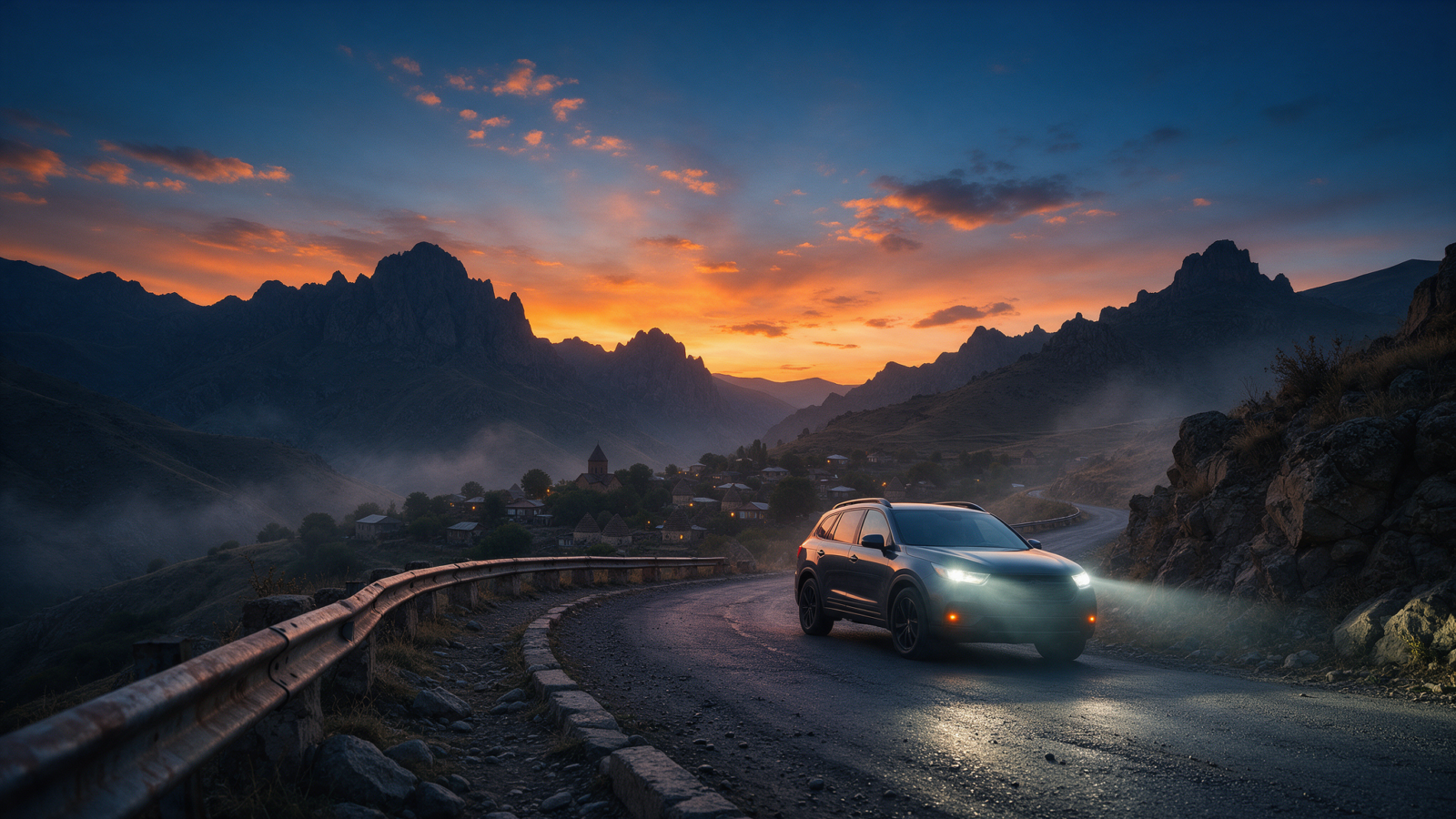
No — every major Western travel advisory that covers Armenia in any detail warns against driving outside cities and towns after dark, and once you’ve driven the roads yourself the reasons are obvious. Rural stretches are unlit, local traffic doesn’t behave like a highway, and the mountain hazards that are manageable in daylight — a pothole, a rockfall scar, a broken edge — are the ones you don’t see in time at night.
What the advisories actually say
The UK Foreign, Commonwealth and Development Office is the most direct of the four: “avoid driving outside of cities and towns in the dark.” It’s a specific, deliberate line, not boilerplate — the FCDO also states plainly that “the standard of driving is poor” in Armenia and tells travellers to “be prepared for drivers who drive recklessly and ignore traffic laws.”
The German Auswärtiges Amt makes the same point in its own terms, describing the accident risk in Armenia as significantly higher than in Germany (“erheblich höher als in Deutschland”). Italy’s Farnesina is blunter still about driving culture, describing the general standard as not generally guided by criteria of adequate caution (“non è in genere ispirata a criteri di adeguata prudenza”). All four advisories we track — British, German, Italian and American — agree on the underlying point even where their wording differs: Armenian roads are fine, Armenian driving standards are the variable you need to plan around, and darkness removes your main tool for compensating, which is seeing the problem coming.
| Advisory | What it says, in its own words |
|---|---|
| UK FCDO | “Avoid driving outside of cities and towns in the dark.” Standard of driving described as poor |
| German Auswärtiges Amt | Accident risk “erheblich höher als in Deutschland” — significantly higher than in Germany |
| Italian Farnesina | Driving culture “non è in genere ispirata a criteri di adeguata prudenza” — not generally guided by adequate caution |
Why night specifically is riskier here
Outside town centres, Armenian rural roads are unlit. There is no streetlighting to fall back on once you’re past the last built-up stretch, which means your headlights are doing all the work — spotting the pothole, the cyclist without lights, the tractor pulling out of a field track, the person walking on the road because there’s no separate verge. None of that is unusual for a rural mountain country; it’s just harder to react to once the sun is down.
The German Auswärtiges Amt adds specifics that matter after dark in particular: defective traffic lights and inadequate signage in places, landslides especially in winter and after rain, and missing drainage. It also singles out rockfall warning signs as worth taking seriously — “Steinschlag-Warnschilder sollten ernst genommen werden” — and rockfall debris is a real, current hazard on at least one major route: the Tatev bypass road was built without rockfall netting installed, so debris on the carriageway does occur. All of these are far easier to spot and avoid in daylight than by headlight.
The FCDO adds a seasonal note worth knowing even if your trip isn’t in winter: “roads are in a poor state, particularly in the coldest months, from November to February.” Combine a rough surface, no lighting, and drivers the advisories themselves describe as inconsistent, and night driving outside towns stops being a convenience and starts being a real source of risk.
How to actually plan around it
The fix isn’t complicated, it’s just a scheduling discipline: build every day’s drive around an arrival time, not a distance. Armenia’s mountain roads average 50–60 km/h in realistic planning terms, not the 90 km/h a straight-line map distance might suggest, so a route that looks short on paper can still eat most of an afternoon. Yerevan to Goris, for instance, is 237 km and plans out at 3 h 45 min to 4 h 30 min — know your sunset time and work backward from it before you set off, not while you’re already on the road.
Our winter driving guide sets a specific rule for the coldest months — be off any mountain pass by four in the afternoon. That’s a winter-specific cut-off built around short daylight hours and ice risk, but the underlying logic holds in every season: know when it gets dark where you’re headed, and don’t be planning your descent from a pass after that point, regardless of the month.
If a delay pushes you into driving after dark anyway, stick to the lit stretches through towns rather than pressing on over an unlit pass, slow down further than feels strictly necessary, and don’t attempt a mountain crossing at night if there’s any alternative — including simply stopping for the night and finishing the drive in daylight. It is a far better outcome than a night crossing of a pass you don’t know.
Night driving, in short
- Every major advisorySays avoid driving outside towns after dark
- Rural roadsUnlit once you’re past the town limits
- Road conditionWorst November–February per FCDO
- Winter pass ruleOff any pass by 16:00 in midwinter
- Plan byArrival time, not straight-line distance
Where you see a rockfall warning sign — the Debed canyon and the Tatev bypass road are the two places this is most relevant — treat it as current information, not routine signage. The German foreign office specifically calls this out, and the Tatev bypass in particular was built without rockfall netting, so debris on the road is a real possibility there, day or night.
None of this means Armenia is unusually dangerous to drive in generally. On the main roads, in daylight, with reasonable care, it’s a straightforward country to self-drive. Arriving at your accommodation, whether in Yerevan, Goris or Dilijan, before dark rather than after it is simply the one habit that removes most of the risk the advisories are pointing at. If you’re heading in from Zvartnots airport on a late flight, that specific transfer is a short, lit stretch of a major road into the capital — a different matter entirely from a rural or mountain drive after dark, and not what this caution is about. For the wider rules of the road, see our guide to driving in Armenia.
Plan the day, not just the car
Tell us your route and we will tell you honestly whether your schedule gets you off the road before dark.
Questions people actually ask
Is it safe to drive at night in Armenia?
Within towns and cities, it’s manageable. Outside them, every major Western travel advisory we’ve reviewed — British, German, Italian and American — warns against it, citing unlit rural roads, inconsistent driving standards and road conditions that are harder to judge in the dark.
Why do the advisories specifically warn against night driving?
Rural roads have no streetlighting, road quality is worse in the colder months, and hazards like potholes, rockfall debris and poor signage are far harder to spot by headlight than in daylight. The advisories also describe driving standards in Armenia as inconsistent, which compounds all of the above.
Does this apply if I land at Zvartnots airport after dark?
The drive from Zvartnots into central Yerevan is a short, lit stretch of a major road, which is a different situation from a rural or mountain drive at night. The caution in this guide is about routes outside towns, not that specific airport transfer.
Is night driving only risky in winter?
No. Unlit roads and inconsistent driving standards are year-round conditions. Winter adds ice, shorter daylight hours and a specific rule from our winter driving guide — be off any pass by four in the afternoon — but the core caution about rural night driving applies in every season.
Which roads carry the biggest after-dark risk?
Mountain passes generally, plus specific stretches flagged for rockfall — the Debed canyon and the Tatev bypass road in particular, the latter built without rockfall netting installed. Any unlit rural road after heavy rain is also higher risk due to landslide potential.
How do I make sure I arrive before dark?
Plan by drive time, not straight-line distance — Armenia’s mountain roads average 50–60 km/h in realistic terms. Check your sunset time for the day and region, and work your departure time backward from your planned arrival rather than starting whenever feels convenient.
Is Armenian driving generally dangerous?
On main roads in daylight with reasonable care, it’s a straightforward country to self-drive. The advisories’ concerns are specifically about inconsistent driving standards and rural night conditions, not about the road network or the country broadly.
Last verified 25 September 2026. Advisory quotes from the UK Foreign, Commonwealth and Development Office, the German Auswärtiges Amt and the Italian Ministero degli Affari Esteri (Farnesina), current at time of writing. Drive-time planning figures assume a mountain road average of 50–60 km/h rather than machine-estimated speeds. Advisory positions change; check your own government’s current guidance before you travel.