The Debed Canyon: Haghpat, Sanahin and Odzun
24 September 2026
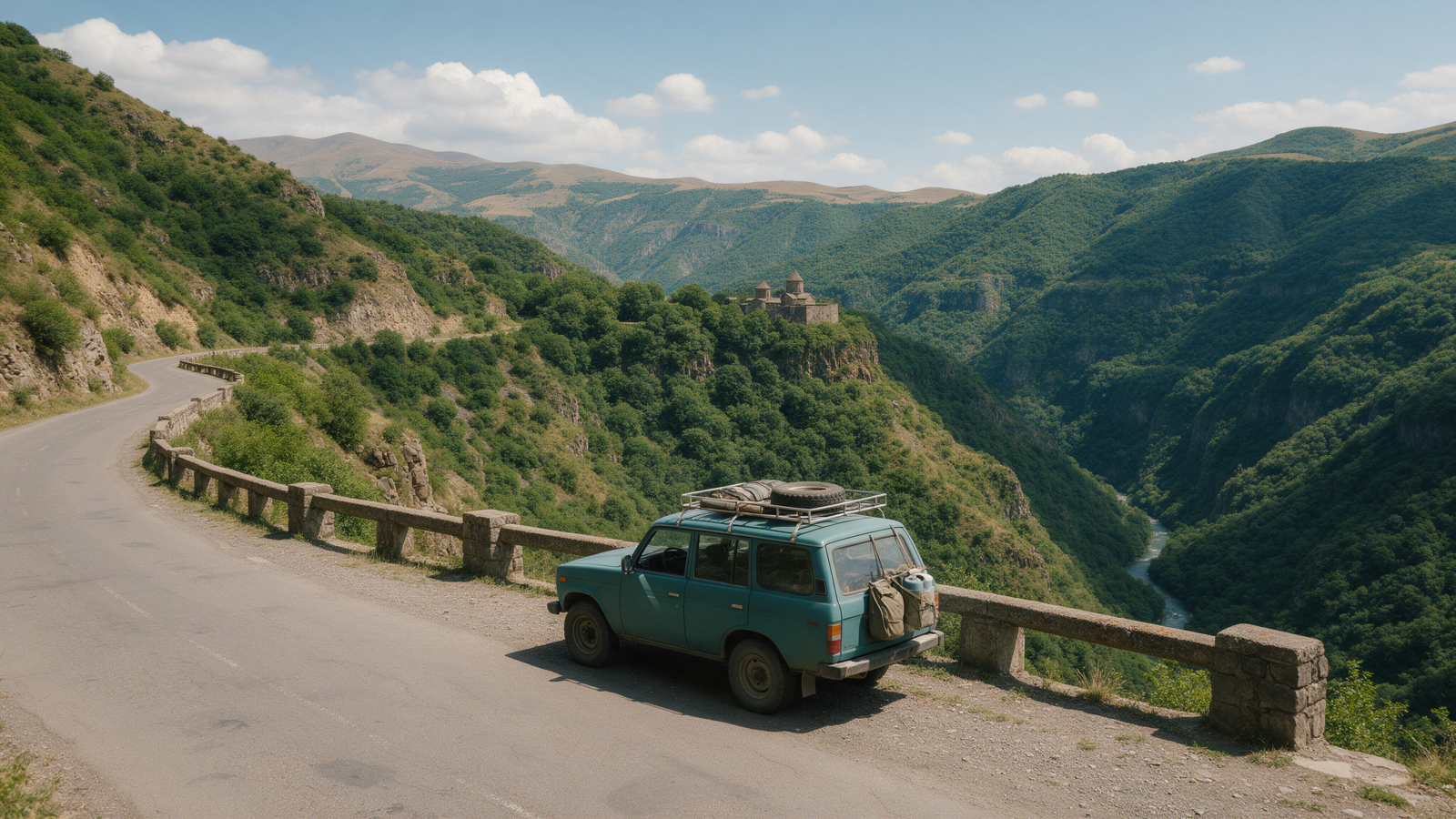
The Debed canyon in Armenia’s far north holds two UNESCO World Heritage monasteries within sight of each other — Haghpat and Sanahin — plus the older church at Odzun and the fortress-monastery at Akhtala further up the gorge. All of it sits just off the M6, the same road that carries traffic on to the Georgian border at Bagratashen, so most people drive straight through without stopping. That’s the mistake. Fill the tank in Vanadzor before you go in: Alaverdi’s stations are thin, and there is nothing at all on the road between.
A canyon worth the detour, not just the crossing
Haghpat and Sanahin are two of the most important Bagratid-era monasteries in Armenia, built in the 10th century on opposite sides of the same gorge, and inscribed together as a single UNESCO World Heritage site in 1996. That’s an unusual amount of medieval Armenian architecture concentrated into a couple of hours’ walking, and because the canyon is also the corridor everyone uses to reach Georgia, it’s easy to let it become a drive-through rather than a stop.
The two sites read as a pair rather than a single visit. Haghpat has the more complete monastic complex — church, bell tower, and a book depository built to protect manuscripts from fire, which tells you something about what the monks here valued. Sanahin, a short distance away across the gorge, was known for its academy and scriptorium and functioned for centuries as something close to a medieval university. Seeing both in one afternoon, rather than picking one, is what makes the detour worth the extra hour.
Getting there
There are two practical ways up from Yerevan: via Gyumri and the M1, or via Vanadzor and the M6, which was fully rebuilt in its final stage in 2023 — new bridges, tunnels and lighting the whole way to the border. Either way, you end up on the same road once you pass Vanadzor. From Gyumri, it’s 115 km to Alaverdi, budgeting 2 hours to 2 hours 15 minutes on mountain roads. From Alaverdi, the turn-off to Haghpat is a short 16 km climb, 20 to 25 minutes.
| Leg | Distance | Plan for |
|---|---|---|
| Gyumri → Alaverdi | 115 km | 2 h – 2 h 15 |
| Alaverdi → Haghpat | 16 km | 20–25 min |
| Sanahin | — | A few minutes from Alaverdi, on the far side of the gorge |
| Odzun | — | A short further climb onto the plateau above Alaverdi |
Fuel is the detail people miss. Vanadzor is the last town with the kind of station density you can rely on — fill up there, before you turn onto the M6 toward Alaverdi. It’s the same pattern we flag for the Selim Pass and the Aragats road in our winter driving guide: treat the gorge as having no services, and plan around the last real town rather than the one you’re about to enter.
Haghpat and Sanahin, the two UNESCO sites
Haghpat sits above Alaverdi with wide views down the gorge, and it’s the more visited of the two — the bell tower and the book depository are the standout structures, alongside a working church. Sanahin is quieter and, if anything, architecturally denser: several connected church and academy buildings from the same Bagratid period, reflecting its role as a centre of learning rather than purely a monastery. Neither charges the kind of clearly published entrance fee you’ll find at Garni or Amberd — we found no current ticket price for either site, so budget nothing beyond parking and treat it as a bonus if that changes.
Both approach roads are paved and neither needs anything but an ordinary car. The whole Debed canyon, including Haghpat, Sanahin, Odzun and Akhtala, is one of the places where a sedan is genuinely fine — the switchbacks up to each monastery are steep enough that a bit of extra clearance feels comfortable, but it was never a requirement.
Odzun and Akhtala, if you have the extra hour
Odzun sits up on the plateau above Alaverdi, a short further drive from Haghpat and Sanahin. It’s an older building than either — a distinctive two-tier arcaded church rather than a monastery complex — and it’s a good contrast to the Bagratid sites if you want to see how the architecture developed over a few centuries. Akhtala, further north again toward the border, is a fortified monastery best known for its well-preserved medieval frescoes, painted when the site was used by the region’s Georgian Orthodox community. Neither is a long detour once you’re already in the canyon, and both are reachable on paved roads.
This is one of the stretches we flag in our winter driving guide — freeze-thaw cycles bring rockfall down onto the Debed canyon roads, and black ice is regularly reported around Tumanyan, further up the gorge. None of that describes a summer or shoulder-season drive here. In good weather the switchbacks up to each monastery are simply scenic, and the canyon is one of the more relaxed stretches of driving in the north.
On to Georgia
Because the M6 continues straight through to Bagratashen, the Debed canyon is naturally a stopping point on the way to Georgia rather than a separate trip. Bagratashen–Sadakhlo is the main crossing, open 24/7, with fuel available within 500 metres of the border post on both sides. If Haghpat and Sanahin are the last Armenian stop before you cross, our guide to taking a rental car from Armenia to Georgia covers the paperwork, the insurance, and what to expect at the border itself.
If the canyon is one leg of a longer loop through the north rather than a standalone trip, our self-drive itinerary guide covers how it sequences with Dilijan, Sevan and Gyumri without doubling back on yourself.
Debed canyon, at a glance
- Alaverdi → Haghpat16 km, 20–25 min
- FuelFill up in Vanadzor — Alaverdi’s stations are limited
- UNESCO sitesHaghpat and Sanahin, inscribed together in 1996
- Car neededAny sedan — the whole canyon is paved
- Georgian borderBagratashen, 24/7, on the same M6
Building this into a wider route?
Tell us whether the Debed canyon is a day trip from Yerevan or the last stop before Georgia, and we’ll tell you what car and timing actually fit.
Questions people actually ask
Are Haghpat and Sanahin worth visiting together?
Yes. They’re on opposite sides of the same gorge, both from the 10th century, both part of the same 1996 UNESCO inscription, and they read as a pair — Haghpat the larger monastic complex, Sanahin the academy and scriptorium. Most visitors see both in the same afternoon.
Do I need a 4×4 for the Debed canyon?
No. Haghpat, Sanahin, Odzun and Akhtala are all reached on paved roads, and a normal sedan handles the switchbacks up to each site without trouble. See our guide to when a 4×4 is actually worth it in Armenia.
Where should I fill up before the canyon?
Vanadzor. Alaverdi has limited stations and there is essentially nothing between towns on the M6 through the gorge, so treat Vanadzor as your last reliable stop before Haghpat and Sanahin.
Can I combine this with driving on to Georgia?
Yes, easily — the Debed canyon sits directly on the M6 toward the Bagratashen–Sadakhlo crossing, which is open 24/7. See our guide to taking a rental car from Armenia to Georgia for the paperwork and insurance side of it.
Is the Debed canyon safe to drive in winter?
It needs more care than in summer. This stretch appears in Rescue Service bulletins for rockfall risk and black ice, particularly around Tumanyan. Winter tyres are legally required across Armenia from 15 November to 31 March — see winter driving in Armenia for the full picture.
How far is Odzun from Haghpat?
We don’t have a precise routed figure for that short link specifically. It’s a further, short climb onto the plateau above Alaverdi — budget well under half an hour on top of the Haghpat and Sanahin stop.
Is there an entrance fee for Haghpat or Sanahin?
We found no currently published ticket price for either site. Budget for parking and treat any entrance charge as a possibility rather than a certainty — it may simply not be formalised the way it is at sites like Garni or Amberd.
Last verified 25 September 2026. Distances are routed on the OpenStreetMap network; drive times are reconciled planning figures rather than machine estimates, assuming a mountain average of 50–60 km/h. Winter road-condition notes come from Armenian Rescue Service bulletins.