Renting a Car in Armenia: The Complete 2026 Guide
24 September 2026
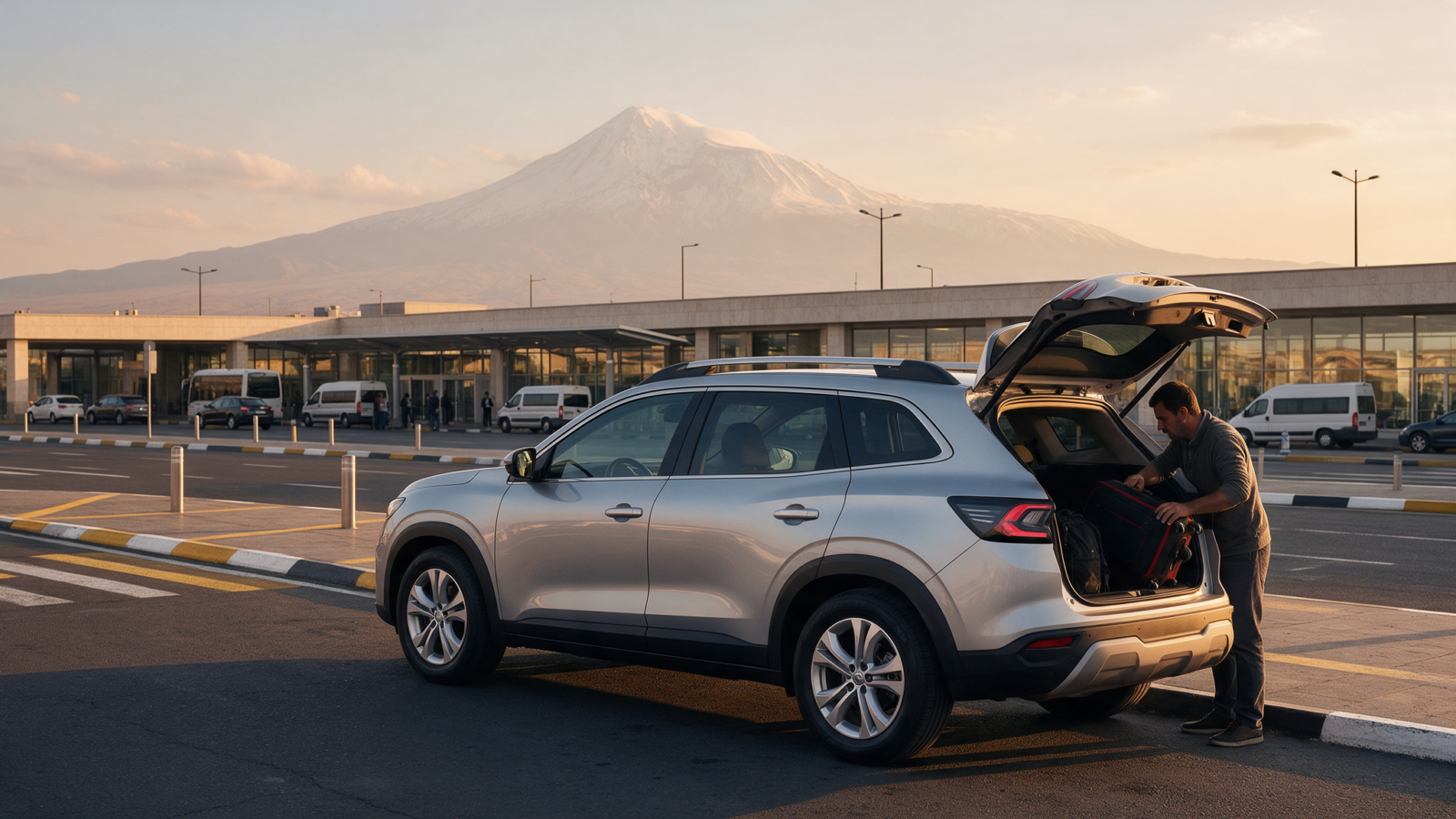
Renting a car in Armenia is straightforward, cheaper than most of Europe, and the only sensible way to see the country outside Yerevan. The parts that catch people out are not the driving. They are the deposit, the excess, the small print about unpaved roads, and whether your licence is accepted at the counter. This guide covers all of it, with real numbers.
On this page
- Why a car, and not a tour
- What it actually costs
- Licence and documents
- Deposits and the credit card problem
- Insurance: what is compulsory, what is not, what is never covered
- Which car to book
- Airport pickup and the first ten minutes
- Driving it to Georgia
- Seven mistakes worth avoiding
- Questions people actually ask
Why a car, and not a tour
Armenia is small and slow. The whole touring map fits inside about 300 kilometres north to south, but mountain roads average 50 to 60 km/h, not 90. That combination is what makes self-driving work here: nothing is far, but everything takes longer than the map says, and a tour bus timetable turns that into a problem.
The practical case is simpler still. The monasteries worth the drive — Noravank at the head of a red limestone gorge, Haghpat above the Debed, Geghard cut into the cliff — are not on public transport. Marshrutka minibuses connect towns, not sights. And the best hour of the day at Khor Virap is the first one, when Ararat is still clear of haze, which no group tour will ever give you.
It is also cheap. A week’s rental plus fuel usually costs less than two people on a guided group tour for three days.
What it actually costs
Armenian rental prices sit well below Western European levels. Indicative market rates start around $25 a day for an economy car and about $49 for an SUV, against a market-wide average of roughly $42 a day across all vehicle types — about $52 in August and about $26 in February.
But the interesting number is not the price. It is the gap between price and demand:
| Month | Demand index | Average rate, USD/day |
|---|---|---|
| February | 29 | 33 |
| May | 49 | 44 |
| June | 62 | 47 |
| August | 77 | 38 |
| September | 81 | 39 |
| December | 30 | 38 |
Demand swings by a factor of about 2.8 across the year. Average rates move by roughly 40 per cent, and not even in the same direction — June is the most expensive month while September is the busiest. Two things follow from that.
First, in Armenia cars run out before prices rise. In late summer the thing to book early is availability, not a bargain.
Second, rental length moves the price more than season does. On the same fleet, a three-day rental costs roughly 25 to 30 per cent more per day than a seven-day one. If you are deciding between five days and seven, the two extra days are close to free.
Fuel, as of September 2026, is around 600 AMD a litre for petrol — about $1.65. A 50-litre tank is therefore about 30,000 AMD, and a 1,500 km loop of the country at 7–8 litres per 100 km works out at roughly 63,000–72,000 AMD, or $175–200.
Licence and documents
Armenia is a contracting party to the 1968 Vienna Convention on Road Traffic. That single fact decides almost everything about licences here.
The Armenian government’s own test, published by the National Services Gateway, is that a foreign licence is accepted if it carries information in Latin letters, marks its categories as A, B, C, D and E in Latin letters, and shows a photo of the holder. Meet those three conditions and your national licence is valid. Fail them and you need an International Driving Permit alongside it — never instead of it.
| Licence from | IDP needed? |
|---|---|
| EU and EEA | No — the national licence is enough |
| United Kingdom | Legally no, but the FCDO advises carrying a 1968 IDP. You cannot buy one outside the UK, so get it before you fly |
| Russia | No — modern Russian licences carry Latin transliteration |
| USA and Canada | In practice yes. Neither country is a party to the 1968 Convention, and at least one major operator in Armenia requires an IDP from US and Canadian citizens |
Rental desks are a separate matter from the law. Individual companies set their own rules, and a few require an IDP from licence holders they are not obliged to — Sixt’s Armenian terms, for instance, ask for one from citizens of Iceland, Ireland, Cyprus, Malta and Spain, which surprises people. An IDP costs very little and removes an argument at the counter. There is a full breakdown in our guide to whether you need an International Driving Permit in Armenia.
Since 2 August 2025, Armenian citizens and dual citizens may drive on a Vienna-compliant foreign licence for only three months after entering the country. After that an Armenian licence is required. This catches diaspora visitors who have driven here on a US or French licence for years without issue.
Bring to the counter: your passport, your licence, an IDP if it applies, and the card you intend to use for the deposit. Keep the rental agreement and the vehicle’s technical passport in the car — police document checks are routine and entirely ordinary.
Deposits and the credit card problem
This is where the Armenian market genuinely differs from Europe, and where almost no guide gives you a number.
International chains operate the model you know: a hold of roughly $500 to $800 blocked on a credit card in the driver’s name. Armenian and regional suppliers mostly do not. Deposits published by local operators run from around 100,000 AMD (about $275) to 400,000 AMD for premium cars, and — this is the part that matters — many accept cash, and some accept debit cards. One aggregator states plainly that its suppliers’ deposits usually do not exceed $300 and can be paid in cash.
Published deposits in the Armenian market, 2026
- Local operator, mid-range car100,000 AMD (~$275)
- International chain, by class50,000–400,000 AMD
- Doubled for drivers under 21 or with under 3 years’ licencecommon
- Aggregator suppliers, typical ceiling~$300, cash accepted
- International chain credit-card hold$500–800
Two groups should read that carefully. Travellers without a credit card — increasingly common — can rent here when they could not in Italy or Spain. And Russian visitors, whose Visa and Mastercard no longer function in Armenia at all, can still rent locally on a cash deposit. We cover that in detail in renting without a credit card, and the full mechanics in deposits and excess in Armenia.
Goyerevan.am’s own deposit, accepted payment methods and age rules are set out on our rental terms page. Check them before you book rather than at the desk.
Insurance: what is compulsory, what is not, what is never covered
Every vehicle in Armenia must carry ԱՊՊԱ (APPA), the compulsory motor third-party liability policy — the local equivalent of what Russians call ОСАГО. It attaches to the car, not the driver, which is why a rental car’s APPA covers anyone authorised to drive it. It is included in every rental and you do not buy it separately.
What APPA does not do is protect you. It pays other people. Its limits rose on 1 April 2026 to 2,500,000 AMD of property damage per injured party and 3,500,000 AMD for life and health. That is roughly $6,900 of property cover — enough for a scraped door, nowhere near enough for a serious collision with an expensive car. The German foreign ministry makes exactly this point in its Armenia advice and recommends full comprehensive cover on top. It is the single strongest argument for taking proper CDW here, and almost no rental site makes it.
Collision damage waiver in the Armenian market costs roughly $8 to $15 a day. Zero-excess upgrades exist: one local operator charges 7,000 AMD a day capped at 49,000 AMD for the rental, against a standing excess of 155,000 AMD.
Off-road driving is excluded outright across the Armenian market, and at least one operator detects it by GPS and forfeits the entire deposit. Missing equipment — the first-aid kit, the spare wheel, the boot cover — is generally not covered even under “full” insurance. Driving after any alcohol, or in breach of traffic law, voids cover. And no police report means no claim, which is close to universal. If anything happens, call the police before you call anyone else.
Many Armenian contracts also exclude damage from unpaved roads, along with tyres, glass and the undercarriage. This is standard across the region but varies by company — read the clause rather than assume.
Which car to book
The honest answer is that a sedan handles more than 90 per cent of Armenia’s tourist map. Garni, Geghard, Khor Virap, Noravank, Areni, Lake Sevan, Dilijan, Gyumri, the entire Debed canyon including Haghpat and Sanahin, Tatev by either the cableway or the gorge road, Sisian, Goris, the Selim Pass in summer — all of it is paved, and all of it is fine in an ordinary car.
There are three real reasons to pay for an SUV:
- Khndzoresk. The last three kilometres to the swinging bridge is gravel full of potholes, and worse after rain. This is the one mainstream site where a sedan genuinely struggles.
- Shoulder season and altitude. Kari Lake sits at 3,200 metres and the road is closed from late November to mid-May. In the weeks either side of that window, clearance and grip buy you margin.
- Winter, anywhere in the mountains. Between 15 November and 31 March winter tyres are legally mandatory, and on the passes they are the minimum rather than the answer.
Everything else is comfort. The full route-by-route breakdown is in do you actually need a 4×4 in Armenia.
One more consideration: transmission. Manual cars are more common in Armenian fleets than in Western Europe, and automatics typically carry a premium. If you cannot drive a manual, filter for automatic at the booking stage rather than hoping.
Airport pickup and the first ten minutes
Zvartnots is about 12 kilometres west of central Yerevan and most arrivals from Europe land late at night or very early. Take delivery at the airport if you can — the alternative is a taxi into town and a second trip back out.
Then spend ten minutes on the car before you drive it away. Film a slow walk-around with your phone, including the roof, the wheels, the windscreen and the underside of the bumpers. Open the boot and confirm the spare wheel, the jack and the first-aid kit are there, because missing equipment is chargeable and rarely insured. Photograph the fuel gauge and the odometer. Check the tyres — in winter, check they are actually winter tyres.
This takes ten minutes and settles every argument that could otherwise happen on the day you fly home.
Driving it to Georgia
Yes, with paperwork, and only with the company’s written permission. Georgia requires a notarised power of attorney from the registered owner whenever the driver is not the owner, which a rental always triggers. The rental company issues it; you cannot arrange it yourself.
Published Armenian cross-border fees run from 15,000 AMD to 28,000 AMD, plus Georgian compulsory third-party insurance bought at the border — the statutory tariff is 30 GEL for 15 days for a car, and 15 days is the minimum policy. Some operators forbid crossing entirely, and taking a car across without permission voids your insurance and forfeits your deposit.
Several rental sites tell you to carry a “Green Card”. Neither Armenia nor Georgia belongs to the Green Card system. A Green Card is neither valid nor required for either country — you buy the local compulsory policy in each. Full detail in our Armenia to Georgia border guide.
Turkey, Azerbaijan and Iran are closed to rental cars without exception. The Turkish and Azerbaijani land borders are closed to everyone; Iran is open but no Armenian rental agreement permits it.
Seven mistakes worth avoiding
- Booking three days instead of seven. The per-day price difference is 25–30 per cent, and Armenia rewards the extra time.
- Assuming your card works. Russian-issued Visa and Mastercard do not function in Armenia at all. Check what deposit method your supplier accepts before you fly.
- Not filming the walk-around. Ten minutes against a disputed scratch.
- Driving into the mountains on half a tank. Stations are plentiful on the M1, M2 and M4 and around towns. On the southern M2 beyond Goris, the Aragats road and remote Vayots Dzor, they are not.
- Trusting the satnav in Syunik. The old Goris–Kapan road passes through territory that is closed to traffic. Navigation apps still route onto it. Follow the signposted Tatev–Ltsen bypass instead.
- Stopping at Yeraskh. The M2 runs within metres of a closed border there. Driving through is fine and normal. Stopping and photographing is not.
- Planning Tatev on a Monday. The cableway is closed every Monday of the year. You can still drive up, but if the cable car was the point, move the day.
See what is actually available
Every car on our fleet page shows its deposit, transmission, drivetrain and what is included, before you book. Free pickup at Zvartnots.
Questions people actually ask
Is it safe to drive in Armenia?
The roads are fine; the driving standard is the risk. Every Western foreign ministry says some version of the same thing — expect reckless overtaking and drivers who treat lane markings as advisory. Traffic, not politics, is what you should plan around. Separately, several roads along the eastern border with Azerbaijan carry travel warnings and should be avoided; none of them is on the standard tourist route, and we list them in our guide to driving in Armenia.
What is the minimum age to rent a car in Armenia?
The legal minimum to drive is 18. Rental minimums are company policy and usually 21, with the licence held for at least a year, and surcharges under 25. Some operators require 23 plus three years for larger vehicles, and several double the deposit for drivers under 21 or with under three years’ experience.
Are there tolls or a vignette in Armenia?
No. There is no motorway toll and no vignette for passenger cars in Armenia. Austrian and German drivers primed by vignette rules at home can stop looking for one.
Can I pay the deposit in cash?
Often yes, which is unusual and genuinely useful. Many Armenian and regional suppliers accept a cash deposit, typically up to around $300, where international chains insist on a credit-card hold of $500–800. Confirm with your specific supplier before you travel.
Do I need a 4×4?
Almost certainly not. A sedan reaches more than 90 per cent of what visitors come to see. The genuine exceptions are the final gravel stretch to the Khndzoresk swinging bridge, high-altitude roads in the shoulder season, and anything in the mountains in winter.
How much is fuel in Armenia?
As of September 2026, petrol is around 600 AMD per litre and diesel around 680 — note that diesel is more expensive than petrol here, the reverse of most of Europe. LPG runs at about 250 AMD, roughly 40 per cent of the petrol price.
Last verified 20 September 2026. Licence rules from the Armenian Ministry of Foreign Affairs and the National Services Gateway; APPA insurance limits from the Bureau of Motor Insurers of Armenia, effective 1 April 2026; Georgian border insurance tariffs from tpl.ge. Prices move — we re-check this page each quarter.